Showing posts with label expeditionary learning. Show all posts

24 April 2014

Student Work: 3rd Grade Pinch Pots

Here at Doulos, we don't get to do very many clay projects-- mostly because a lack of resources and space. But last year I purchases a packet of Sculpey over-bake clay. The opportunity finally arose to use it with a class. The third graders studied ancient Egypt for their spring expedition this semester. As they learned about different aspects of that culture and civilization they focused on the different castes and roles in the society. I got to come in and role-play as an ancient Egyptian artisan!

After doing that, it dawned on me that we should create something out of clay like the ancient artisans did...uh duh brilliant art teacher. Integrating into the core subjects (especially social studies) has been such an fun part of my work at Doulos. The students love it because they already are growing experts on a topic and it actually makes my job easier because I don't have to spend a ton of time on history, geography, or other background information because they already know it!

As soon as we started working with clay the students became so excited. They were practically giddy before each art class when I went to bring them to the art room. The shear fact of using a different material I think made them so engaged, but also because they were really learning a new craft (and this class in particular loves learning new things.)


After we finished our pinch pots, the students filled out a little reflection form like we do after most projects. Some of their responses were too great not to share!


When you look at your artwork how do you feel?

"... good, because I'm learning how to do new things."
"...delightful, because when I see it, it reminds me that I am an artisan."
"...good, because it is an artwork, a real cool artwork."
"...happy, because now I have something to put stuff in."

What will you put inside your pinch pot?

"...candy, or something that I can eat."
"...my collection of little rocks."
"...5 pesos to buy cornflakes" (every cereal here is referred to as "cornflakes")
"...money, a marble, or a necklace."
"...my secret things that no one is going to know."
"...salchichitas."  (translation: little hot dogs)

If you could make anything out of clay, what would you make next?

"...a bird or a worm."
"...a heart pinch pot or a star pinch pot."
"...a clay bird lid and a nest pinch pot as the bottom."


You'll notice that many students styled their pinch pot and lid like little beetles. This is because we also spent time discuss the symbol of the scarab beetle in ancient Egyptian culture.

21 March 2014

Classroom Commotion: The Love/Hate Relationship between 4th Graders and Weaving

If there ever was a project that 4th grade students struggled incredibly with, it was weaving with yarn. If there ever was a project that 4th grade students couldn't get enough of, it was weaving with yarn. Here's a little break down of how it goes each year...

Class 1: We learn about weaving as an key component to South American indigenous cultures as a form of folk art and work with simple over-under weaving with construction paper looms and paper strips. Level of engagement- above normal. Level of enthusiasm- varying.


Beginning of Class 2: The idea of weaving on a cardboard loom with yarn is presented and demonstrated. Level of engagement- very high. Level of enthusiasm- very high. This is generally the point in which students believe they are already master weavers and therefore ignore all my instruction and rush me along to get their hands on their materials.


Approximately 5 minutes later into Class 2: Students working independently on their weavings. "Mrs. Kerrie!" is reverberating off the walls. Knots are growing larger by the second. Tears beginning to form in the corners of meek student's eyes. ADHD student is wiggling uncontrollably in and out of the chair. Overachieving student is almost finished with wrapping the yarn around the entire loom with out a single string woven. Level of engagement- very high. Level of enthusiasm- the lowest of lows. This is generally the point in which I, the art teacher, wonder why the heck I thought this was such a successful lesson last year. In my head I think, "Where the heck are my freaking scissors, I'm just going start cutting all these strings loose, screw this "brilliant" idea of making a bag let's just stick to freaking place-mats."


The rest of the duration of Class 2: Review is offered for how to make a pattern of over-under-over-under with the yarn. Knots mitigated. Undoing of mistakes done and redone. Multiple sighs heard from students and myself alike. I pray that a glimmer of hope would just shine it's yarn-y face upon us. Looms are packed up for homework. Level of engagement- below normal. Level of enthusiasm- regaining steam to below normal.

Approximately 15 minutes into the next period: One or two students pop into my classroom showing me their weaving success and asking for more lengths of yarn to continue working! (why are there here during another class period? Are they really that sneaky?)


At the end of the school day of Class 2: Over half the class has come and gotten more yarn (some students more than once) so they can continue their weaving. They are showing me their work anytime I see them on campus. Students tell me their plans to work on it over the weekend. Level of engagement- very high. Level of enthusiasm- miraculously high. Now I realize why I wanted to repeat this lesson.


One of the design principles of expeditionary learning is success and failure. This weaving project encompasses both so perfectly for these 4th graders. With in one class period we all hit a point of wanted to give up and thinking that this task is impossible. Then when the light blub flashes on, it does so like a 180 degree turn and BAM! The students love weaving! They can't believe that by the end they will have made their own little bag and they are literally waiting for me at my classroom door to get more yarn to work ahead. I couldn't ask for more ownership over their work!

09 March 2014

Classroom Commotion: High School Students Are Choosing


I have once again reinvented the high school visual art elective class. Leave it to me, right before bowing out of my position at Doulos, to have yet another grand idea of how to improve the high school class. The new system I have devised is based off of the Teaching for Artistic Behavior model of arts education that I have been researching. In a nutshell the TAB methodology is a choice-based model where students rotate through modules based on their personal interests. I did not come across very many examples of this being played out in other high school classrooms, but I think this is mostly because in the "average" high school there are already choices of different visual arts classes a student can take. However, Doulos is not able to offer that. That is what originally lead me to my adoption and adaptation of this particular classroom structure.


One of the main things I hoped to address and tackle with this new model was having a conglomerate of students at various levels of experience in the visual arts. Because our school only offers one visual art elective block per semester, I could have the full spectrum of students in my class at any give semester. This model allows my students the freedom to choose mediums, subject matter, and a selection of learning targets from a given list. I won't bore you with all the details, but essentially now my little group of high school art students are evaluating both their artistic interests and goals and pursuing them!


We're still working out all the kinks, but so far we are off to a great start! It's my hope that in the years to come this model can be maintained for the art "department" at Doulos. I would love to see what the TAB model might look like at younger levels, because it melds so well to the expeditionary learning principles we uphold at our school. I am a self-taught artist myself, and I firmly believe every student has the potential to unearth their creative identity if given the time, space, and resources. I'll be sure to post some more photos of the sketchbook assignments these high schoolers have been working on!


20 October 2013

Student Work: Elementary Art Goes Into the Garden

Here's another very belated post about a study I did with the 2nd, 3rd, and 4th graders last year in the spring.


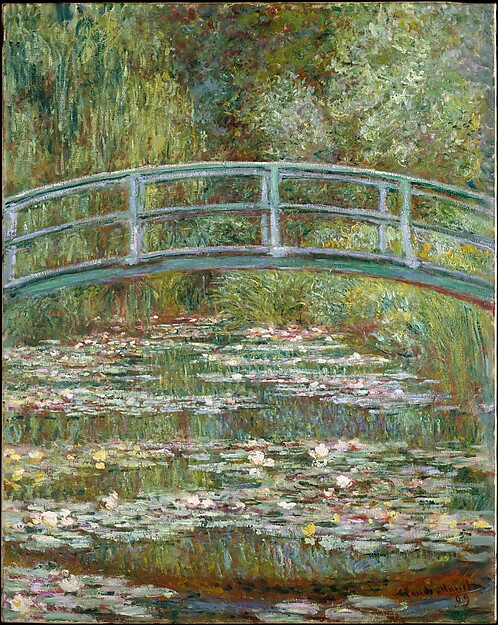
It occurred to me at some point last April that Doulos students love to spend time in our garden just like Claude Monet did. This simple revelation seemed to clearly lead me to the conclusion that these kiddos needed to learn about Monet's artwork and methods! They are already like mini Monets!

The students are always running around the garden during recess or lunch time. The pond is an infinite source of fascination for them. Between the fish, stones, mango tree, and all sorts of flora, our students are drawn to this lovely little garden. Not only is it used during play time, but often classes go out into the garden during reflection times. A place of peace and play-- what could be better! It is such an integral part of our campus, the center focus and defining feature.


And much like Monet's garden in Giverny, our bright red, Japanese-style bridge is a focal point.

Bridge over a Pond of Water Lilies


 The elementary students loved learning about Monet and his special garden. We took time to draw outside working on our observation skills. Then we made the connection that we have a bridge just like the Giverny garden! That's when our final artworks emerged...


The end results are like Giverny with a touch of Doulos! I am already looking forward to studying Monet again this next year with the new 2nd graders!


*Bridge over Pond of Waterlilies by Claude Monet via metmuseum.org

06 May 2013

Expedition Projects: Spring 2013

Another round of learning expeditions has come and gone. This spring semester I upgraded the art integration for many of the classes' expeditions based on my own trial and error learning process over the last few years. And I am happy to say that I think I finally landed on some keepers!

This is specifically true with the 3rd grade unit on Ancient Egypt. There is really too much a teacher can do with Ancient Egypt, and I felt like everything I had seen or attempted wasn't worth repeating because it was either too kitschy, didn't cover standards, and/or was going to end up in the trash a week later. I want the art integration I do to be authentic, not forced or meaningless. So this year with 3rd grade we spent some time creating these wonderful Egyptian profiles based on artworks we studied from ancient tombs (inspired by this artsonia gallery). I also wanted to do a little clay project with the oven-bake clay a generous work team brought me, so we did these quick and easy clay scarabs.

for some reason I can't get this photo to orient correctly...sorry for the neck ache.


The 4th grade studied the Incan Empire for their spring expedition. In their art class we study the Inca's geometric designs and weaving. In the past we have done flat yarn weavings on cardboard looms. However, this year I used this excellent tutorial for making our weavings into functional pouches! The students always huff and puff when we start this project, but by the second class they are tracking me down all over campus because they need more yarn to keep working! I love their enthusiasm for creating something! One student who particularly struggled and had a bad attitude at the beginning told me at the end, when we are tying up all her strings, "I am excited about my bag because I am proud that I can say 'I made this.'" Bah! That comment made my week!


In the spring semester I teach a drawing basics class to the 8th graders. Their spring expedition is on freshwater eco-systems. Their science units for their expedition happen to fall right when we are starting our drawing from nature unit in art (what a coincidence :) We study techniques for drawing implied texture and amp up what we've already covered on value by switching from pencils to ink. Each student had to choose a view from our local Rio Yaque to communicate in their drawing.


Some of these lovely pieces will be displayed in the 2nd annual Doulos Art Gallery on Friday. Stay tuned for all that goodness soon!

23 December 2012

Expedition Projects: Fall 2012

As an expeditionary learning school, each semester culminates in extensive and integrated learning units we call expeditions. Because I am a K-12 teacher, that means that I get to have a little hand in all the different expeditions, mostly through helping the guide teachers have some beautiful and relevant artworks to present to the community on our open house night. I actually enjoy this part of my job a lot. While there is plenty to teach about the visual arts as it's own subject matter, I like the challenge of finding ways to integrate the content of their learning expeditions into what we are learning as an art class. Here are a few samples of what the student's accomplished.

The third grade class in front of a mini mural they did of the ocean habitat for the sea animals they studied.

Each third grader studied a particular sea animal and how we help and harm them and their environment. In art class we did oil pastel drawings and watercolor resists of their animals that we later used as awareness "posters".

The first graders studied healthy habits and healthy eating. They made paper collages of a healthy meal option they wrote in the recipes for in Spanish class.

The kindergartners studied helpful and harmful insects. We did a few little projects with insects, these are just a few  mixed media buzzing buddies.

The fifth graders once again did detailed drawings of the endemic birds of the DR that they studied, but this year we took a different spin on them and used watercolors on our final ones and did close-ups of the field markings for each bird.

The sixth graders studied and applied the scientific method in various experiments. In art class we had a blast using the same process to study Jackson Pollock's works and research his unique painting technique.
I don't have an art class with the 11th graders this year, but I guest taught in their social studies class to help them create stencils that synthesized their reflections using written and visual expressions. For their expedition they studied cultural conflict and they used their learning to inspire these messages to their community.

GERMS! The second graders went wild with their  creative germ drawings from their imaginations. They each made up a germ villain and created a wanted poster for it for their programa de noticias de germenes.


26 November 2012

Classroom Commotion: High School Outings and Junior High Mustaches

Sometimes I get really excited about some small detail of a lesson or some little moment in class when it all seems to fall into place. These are the quiet affirmations from God that I feel He gives me to encourage me in the work I do. It is very rare that anyone else is in the classroom with my students and I. But through these little gifts, I am reminded that the Lord is with me and loving the learning of my students.
Here are a two examples...

A few weeks ago my high school students were exploring drawing people en vivo, specifically practicing gesture drawings. I wanted to challenge them a little more so I gave them all oil pastels to work with rather than their comfortable tools of pens or pencils. As promised in our class constitution, we were due for an inspiration-seeking outing. So we headed for the central park for a few days. This year the high school elective class meets four days a week, compared to the one day a week allotted the previous years. I love that I can now really dig into concepts and techniques with these students AND give them class time to practice and develop them. Once we got to the park the first day, they took some time to warm-up and it was difficult for them to open their eyes to see and draw what was around them in such a busy place. But by the last day we were there I had to ask them to stop working so we would not be late in returning to school. It was evident that they just needed the time and space to find a groove and from there on they were hooked. We continued to work outside the classroom the following weeks in drawing landscapes around the Doulos campus.


The past couple weeks the sixth grade class has been working on a project on the Abstract Expressionists, with a focus on Jackson Pollock. We are integrating their science expedition on the scientific method by doing an "art experiment" about the differences between using a brush and throwing paint with other objects (like Pollock did).  We created a collaborative painting using brushes that will serve as a comparison to their other thrown-paint artworks they will do this week. As we were planning our procedures and materials, in accordance with the scientific method, one student mentioned off-hand that we needed berets or mustaches as we painted.  Of course I couldn't let that go unheard. When they entered the classroom the next day on their desks they found personal paper mustaches! Haha, so fun! We all (yes I wore one also) sported the mustaches all class and some even into their next few periods. That little detail lifted the whole mood of the class. They were very successful in mixing their two personas of artist and scientist, especially as we recorded our observations like scientists do but with an artist's eye and art vocabulary.